MemAff: Retrieving and Grounding Affordance Objects in Long Visual Memory
First-author paper submitted to ICLR 2027 (under review). My work studies memory-grounded affordance prediction: retrieving the frame containing an intended object from a long visual history and localizing that object at the pixel level. MemAff combines coarse retrieval, VLM reranking, and visual grounding; MemAff-Bench evaluates retrieval and localization jointly across real-world video sources.
Diagnostic probes investigate why projector normalization can cause an abrupt drop in vision-language-action performance. Controlled OpenVLA experiments connect the cliff to attention-sink collapse and shifts in the visual attention budget, with cross-architecture probes on pi0.5. This research combines distributed fine-tuning, attention analysis, and reproducibility checks.
Benchmark Radar is a living database and search engine for AI benchmarks and evaluation. It connects benchmark discovery with datasets, code, reported scores, and source evidence.
My merged open-source contributions include an agent-benchmark digest connector, preservation of source evidence across paper revisions, recovery of cited benchmark release dates, and fixes that distinguish unreported adoption counters from measured zero.
Benchmark Radar 是持续更新的 AI 评测基准数据库与搜索引擎。我参与了智能体评测信息源接入、论文修订时的证据保留、基准发布日期补全,以及缺失使用量指标的处理。
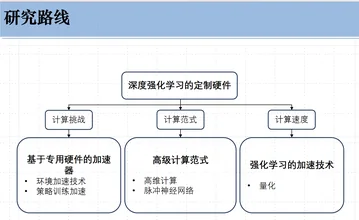
This survey explores the development of domain-specific architectures for reinforcement learning (RL), highlighting advancements and challenges in implementing RL on specialized hardware. As RL algorithms grow more complex and computationally intensive, custom hardware solutions offer promising pathways to enhance performance, energy efficiency, and scalability. We review different architectures designed to accelerate RL algorithms as well as key contributions for various fields such as IoT applications, hardware prefetching and processors. Previous work primarily focused on either FPGA or GPU implementations, lacking extensive performance comparisons across various RL algorithms and configurations especially the modern ones. They also lack detailed discussions on integrating advanced neural network layers like CNNs and RNNs in FPGA designs. Our survey addresses these gaps by providing a comprehensive comparison of FPGA and GPU implementations, emphasizing fine-grained parallelism, on-chip memory usage, and integration with software-based environments. Furthermore, we explore near-memory computing and state-of-the-art DRL algorithms on custom hardware. We conclude with future research directions, including integrating advanced neural network layers in FPGA designs and exploring near-memory computing to further enhance RL capabilities on custom hardware.
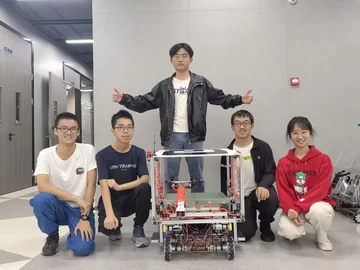
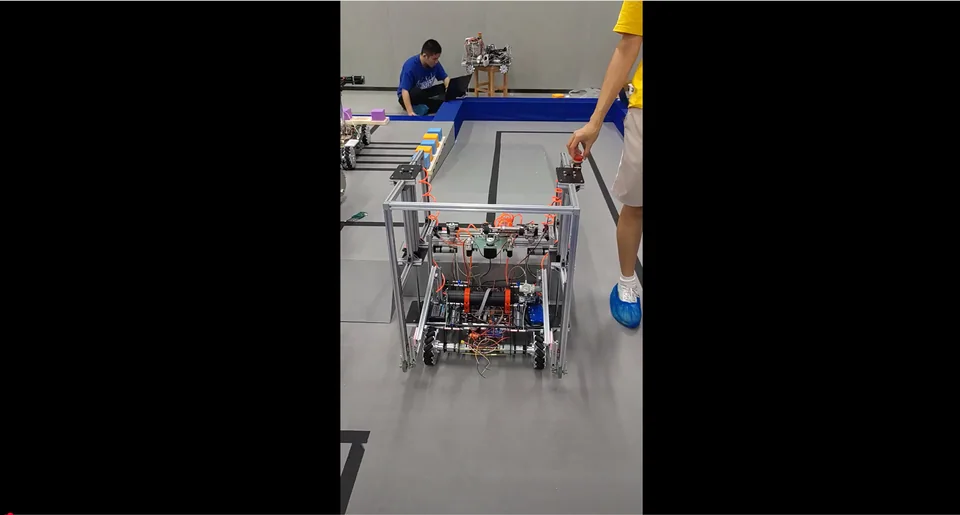
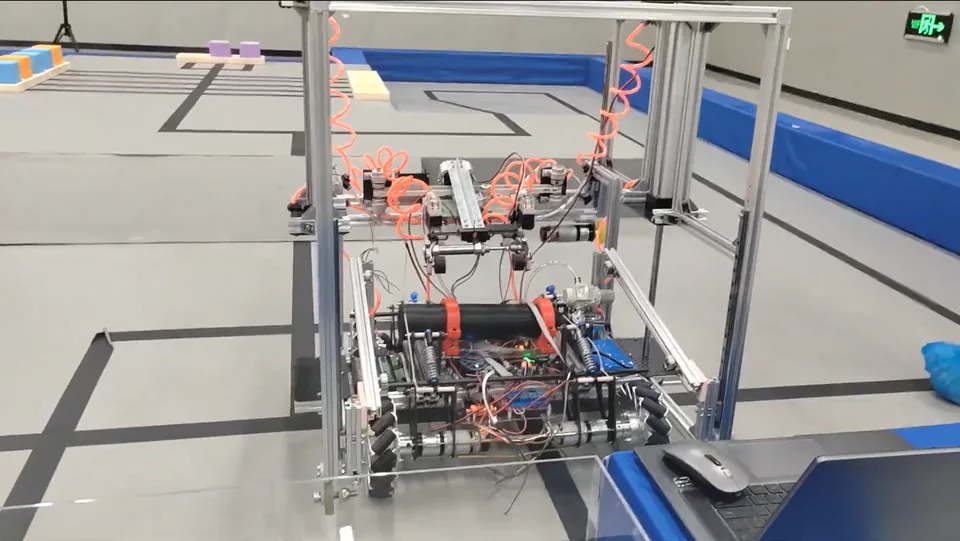
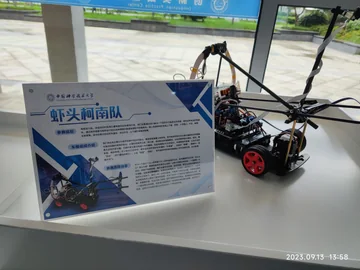
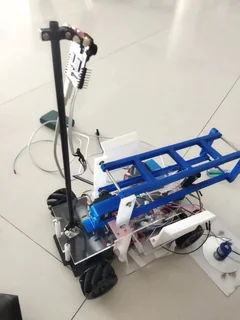
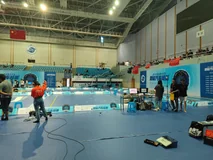
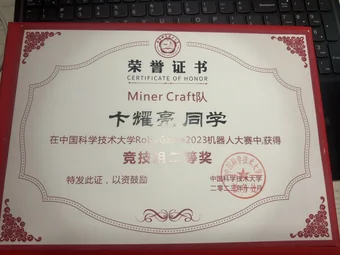
I built a robot with my teammates in USTC’s 2023 Robogame. I was responsible for the operation and maintenance of the core power supply module and the air pump system, as well as assisting with parameter tuning. Our Robot can independently identify, grab ores of different colors and transport them to the designated area in time.
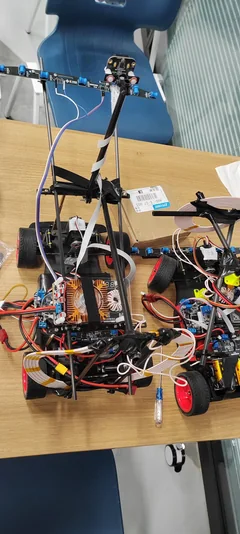
I participated in the power relay group of Anhui division with my passionate teammates, Weixing Chen, Xinyuan Zhang, Boxuan Niu. I was responsible for the PCB design of the core boards for the rescue vehicle and the rescued vehicle of the electrical energy relay team. Weixing Chen and I also provided help to the Duck Yummy team of Shanghai Jiao Tong University in the intelligent vision group of East China Division.
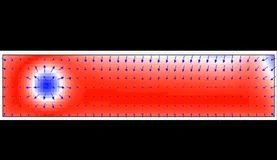
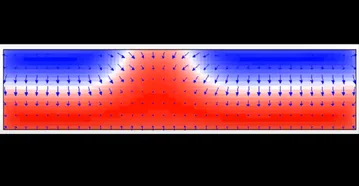
This experiment aims to understand the physical properties and structural characteristics of Skyrmion through learning, and to study the influence of different magnetocrystalline anisotropy constants (PMA) on the magnitude of Skyrmion generated by current, as well as the influence of two-dimensional PMA gradient fields on the driving effect of Skyrmion, using an object-oriented micromagnetic simulation framework software. Finally, the conclusions of the integration leakage ignition model were obtained through program simulation, image analysis, and other methods. At the same time, the simulation process was summarized, reflected on, and improved.
standing out among all 39 competition group teams in USTC Robogame 2023
With Jiazhuo Liu, Zhenglang Weng, Yaxin Gong and Taowei Liu. Supervised by Prof. Huichun Ye.
Team: Miner Craft
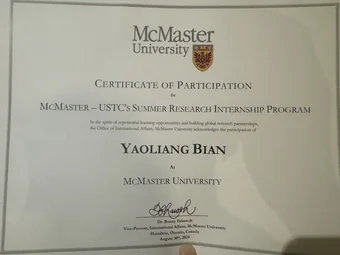
Certificate of Participation in McMaster-USTC'S Summer Research Internship 2024
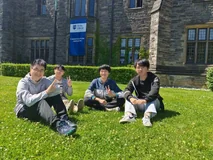
worked in Prof. Ameer Abdelhadi's group on Hardware for Reinforcement Learning
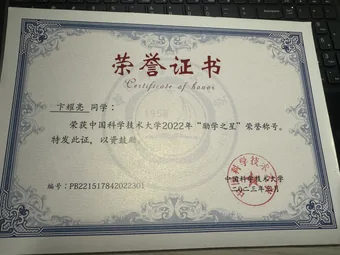
USTC "Star of Inspiration" Honorary Title, 励学之星 (2022) [Report]
- honor for undergraduate and graduate students at University of Science and Technology of China - only 34 among about 25000 undergraduate and graduate students in the school (top 0.1%) - the only 2 freshman to win the award in 2022
During undergraduate studies (2022-2026), University of Science and Technology of China Class of 2022 Electronic Science and Technology (Excellent Class), Publicity Committee Member
2022.12 - 2023.1, University of Science and Technology of China's Winter Vacation Social Practice project - "科技振乡村", Project Leader